Unsolved: Hidden Mystery Games
- 4.7
- Rating
- 10.00M
- Installs
- Free
- Price

 Analysis by App-foxy
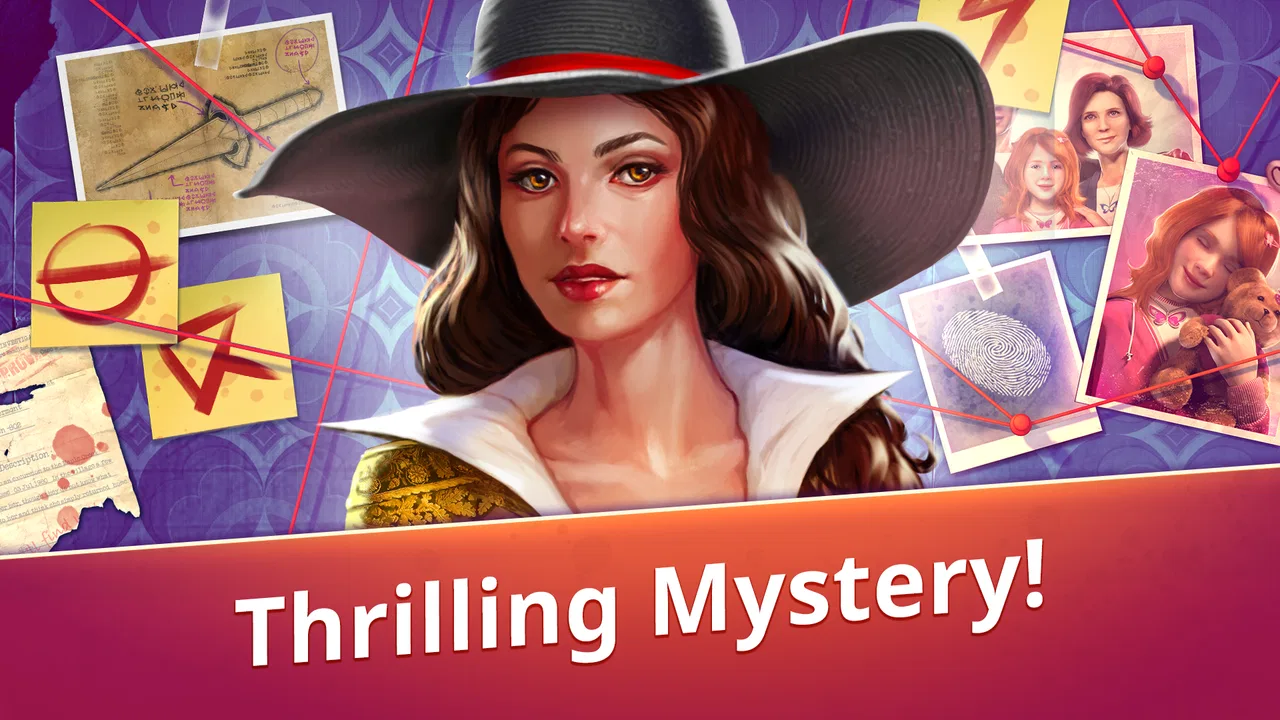
I approached Unsolved: Hidden Mystery Games expecting a collection of casual hidden-object scenes, but Artifex Mundi’s adventure game works better when treated as a series of small investigations. The central appeal is not simply spotting items on a busy screen. It is moving through a criminal case, examining clues, and deciding which mystery deserves my attention next. That combination gives each session a clearer purpose than the usual “find everything before moving on” format.
The game is free to start and aimed at Teen players, which makes it easy to try without committing money immediately. It has also built a substantial audience, with over 5 million installs and a 4.7 average from around 430 thousand ratings. Those figures do not replace personal judgment, but they do match my impression that this is a polished, approachable choice for players who enjoy visual searches with a story wrapped around them.
How the first cases create momentum
The early goals are easy to understand: investigate a case, search for hidden objects, and use what you discover to move the mystery forward. I like that the game gives the search a reason. Instead of opening a scene with no context, I feel as though I am gathering material for an investigation. That small change matters because it turns familiar object-hunting into a sequence of purposeful tasks.
You May Also Like

 Blood Strike: 2.5 Anniversary
Blood Strike’s Loadouts Turn Every Drop Into a Tactical Gamble
A close look at Blood Strike’s custom loadouts: how fast access to signature weapons reshapes its battle royale rhythm, rewards preparation, and narrows the gap between fights.

 Pandora - Music & Podcasts
Pandora’s Music Is Easy to Start, but Harder to Recover
Pandora’s strength is its low-effort path from a seed to a station. Its weak spot is how much confidence it asks you to place in connection, setup, and quiet recovery.

 8 Ball Pool
 Is Built on Rivalries, Rematches, and Routine
A close look at the rivalries, rematches, shared routines, and unanswered safety questions that turn a quick pool match into a persistent mobile community.

 Samsung Music
’s Quiet Strength Is Playing What You Already Own
Its reach comes less from spectacle than from dependable access to a personal library. That simplicity is both the app’s strongest retention engine and its ceiling.

 AccuWeather: Weather Radar
AccuWeather Review: A Quick, Clear Forecast for Everyday Decisions
For everyday plans, the best forecast is the one you can understand quickly. AccuWeather makes rain timing, radar, and local conditions easy to act on, with a few trade-offs.

 Hill Climb Racing
Why Hill Climb Racing Still Turns Crashes Into One More Run
A tiny car, a bumpy hill and one more upgrade: Hill Climb Racing keeps resurfacing because its simple chaos makes every near-miss feel personal.
More From Our News Desk



My first sessions worked best when I treated each scene as a focused observation exercise rather than a race. I scanned the edges first, then checked areas where colors or textures blended together. This is especially useful on a phone, where a crowded image can feel much harder than it would on a larger display. The game rewards patience more than frantic tapping, so slowing down is often the most efficient approach.
The choice of which mystery to solve also gives the opening a welcome sense of agency. I am not locked into one emotional tone or one type of investigation every time I play. When I have only a few minutes, I can choose a case that feels manageable; when I want a longer distraction, I can settle into a more involved chain of searches. That flexibility is one of the strongest reasons I would recommend it over a single, linear hidden-object title.
A practical example is an evening commute or a short wait at an appointment. I can play one scene with the sound off, stop when I reach a natural break, and return later without needing the concentration demanded by a full action game. The crime-solving framing keeps the session from feeling empty, while the visual tasks are simple enough to fit around interruptions.
There is a useful distinction between the game’s immediate goal and its broader goal. The immediate task is concrete: identify the requested objects. The broader aim is to understand the case. That layered structure helps prevent the individual searches from becoming completely interchangeable. Even when the basic interaction stays familiar, the investigation context gives me a reason to continue.
Progress feels clearest through case context
The most convincing progress signal is the case itself. Completing searches feels meaningful because I am not merely filling a meter; I am working through an investigation. The game’s structure encourages me to think in terms of evidence and unanswered questions, which is more satisfying than a disconnected sequence of picture puzzles.
I also appreciate the freedom to choose a mystery rather than being pushed through one uninterrupted campaign. This makes the game easier to use in different moods, but it changes how progress feels. Players who prefer a single, highly directed adventure may find the collection-based approach less emotionally continuous. I sometimes felt more like I was selecting the next television episode than advancing through one long novel.
That is not necessarily a weakness. For casual play, it is useful to have several investigative starting points. The trade-off is that the sense of personal investment depends heavily on whether a particular case catches my interest. If a mystery does not immediately engage me, the hidden-object interaction alone may not be enough to pull me through every scene.
One of my more effective habits was to pause after finishing a scene and mentally connect the objects I had found with the case objective. That sounds simple, but it changes the rhythm. Instead of tapping through the list and instantly moving on, I use the result as a small checkpoint. This makes the narrative side more noticeable and keeps the game from becoming visual clutter followed by visual clutter.
Artifex Mundi’s experience with this style is apparent in the way the search activity remains central without completely swallowing the investigation theme. I would not describe the game as a traditional detective simulator. The emphasis is still on finding objects, but the criminal-case framing gives those searches a recognizable direction and makes the overall package more distinctive than a generic spot-the-item app.
Where the difficulty curve works and where it tests patience
The challenge comes from attention, visual memory, and the ability to interpret a scene quickly. Objects can be easy to notice in isolation but difficult to identify when they blend into the background or appear at an unexpected scale. I found that the game’s difficulty is less about complex controls and more about how carefully I inspect what is on screen.
That makes it accessible to people who do not normally play adventure games. There is no need to learn a complicated control scheme before the investigation begins. The main skill is observation, and improvement comes naturally as I learn to look for silhouettes, unusual color breaks, and items that seem slightly out of place.
However, accessibility does not mean every scene feels equally fair. A hidden object can be technically visible while still being easy to overlook because it shares the surrounding lighting or shape. When that happens, the challenge can feel less like solving a clue and more like searching for a deliberately camouflaged detail. I am comfortable with that occasionally, but repeated moments of uncertainty can slow the pace.
My best approach is to divide the image into zones instead of sweeping randomly. I check the top corners, borders, central objects, and darker areas in order. I also avoid tapping repeatedly when I am unsure, because random guesses make the search feel more stressful and do not improve my visual understanding of the scene. A methodical scan is slower for the first few seconds but usually saves time later.
The game suits players who enjoy a moderate mental workout without the pressure of a timer-driven action title. It is less suitable for someone looking for increasingly elaborate logic puzzles or a demanding detective system where every conclusion depends on deduction. Here, the investigation atmosphere supports the hidden-object play; it does not replace it with a fully separate reasoning game.
Device size can affect the experience as well. On a phone, small details demand more concentration, while a larger screen makes the visual search more comfortable. That does not change the underlying design, but it changes how tiring longer sessions feel. I would choose a tablet or a larger phone when I want to play several scenes in one sitting, and a standard phone for short bursts.
What keeps me playing, and what can create friction
The strongest retention tool is variety through different mysteries. Having a choice of cases gives me a reason to return when I want a particular kind of atmosphere or simply need a fresh scene. The combination of case context and object searches is more durable than an endless stream of unrelated images because each investigation supplies a small narrative destination.
At the same time, the free-to-play structure deserves attention. The game can be downloaded without an upfront purchase, while in-app purchases range from $0.99 to $99.99 per item. That wide range means I would approach spending carefully. I would first decide whether the basic investigation loop holds my interest, then set a personal limit before buying anything. A free entry point is convenient, but it can also make optional spending feel easier to justify during a difficult search.
This is particularly relevant when I am stuck. A hidden-object game naturally creates moments where I want help immediately, and that is exactly when frustration can influence a purchase decision. My advice is to take a break before spending. Returning with fresh eyes often works better than assuming that a blocked scene requires a paid solution. This habit protects the relaxed tone that makes the game appealing in the first place.
The advertised age classification is Teen, so I would not present it as a children’s game simply because the controls are approachable. The criminal-case theme gives it a more mature atmosphere than a purely playful search app. Parents choosing it for younger players should consider whether that investigative tone is appropriate for them, rather than judging only by the simple tapping mechanics.
Another retention factor is the low barrier to resuming play. I can return after a day away without relearning controls or remembering a complicated strategy. That is ideal for people who want a dependable casual adventure. The downside is that players who need constant mechanical novelty may eventually feel that the search format is too familiar, even when the cases change.
The current version is 3.3.300, and the game supports devices running Android 7.0 or later. For someone using an older phone, checking compatibility before planning a download is sensible. On supported hardware, the important question is not whether the game has demanding controls, but whether the screen is comfortable enough for detailed searches and whether the player enjoys this particular pace.
Who should choose it over other adventure games
I would recommend this game to someone who likes detective themes but prefers relaxed interaction over combat, complicated inventories, or fast reflexes. It is also a good fit for hidden-object fans who want a reason behind each scene. The case structure adds enough direction to make a short session feel complete, while the option to choose a mystery makes the experience less rigid than a strictly linear adventure.
Compared with a traditional point-and-click adventure, the emphasis here is more immediate. I spend less time combining objects or navigating elaborate dialogue trees and more time reading scenes visually. That makes it easier to start, but it also means the game may feel light to players who want deep environmental puzzles and extended exploration.
Compared with a pure hidden-object collection, the criminal investigations provide a stronger sense of purpose. I am not just clearing pictures from a list; I am following a case. The trade-off is that the narrative framing may raise expectations that the game will offer complex deduction. Players seeking a rigorous mystery-solving simulation should look elsewhere, while players wanting accessible investigation-flavored searches are much more likely to be satisfied.
I would skip it if my priority were uninterrupted offline-style relaxation with no temptation to spend, or if I disliked searching for tiny details in visually busy scenes. I would also skip it if I wanted a single, long-form story with a tightly controlled beginning, middle, and ending. The freedom to choose mysteries is useful, but it can make the overall journey feel more episodic.
For a friend deciding whether to try it, I would suggest a simple test: play several early searches without rushing and ask whether the case context makes the object hunt more enjoyable. If the answer is yes, the game has enough structure to become a reliable casual adventure. If the answer is no, later mysteries are unlikely to change the basic interaction that much.
My progression verdict
Unsolved: Hidden Mystery Games sustains play through clear short-term objectives, visible case advancement, changing mysteries, and a search loop that is easy to resume. Its progression is strongest when I care about the investigation surrounding a scene. The game does not need elaborate mechanics to create momentum because the simple question of what happened next gives each search a destination.
Its limitations are equally clear. The core activity remains hidden-object searching, so players who tire quickly of visual scanning may find the long-term loop repetitive. Difficult scenes can also turn curiosity into irritation, especially when an item blends into its surroundings. The free-to-start model is welcoming, but the presence of purchases means I would play with a spending boundary in mind.
After spending time with it, I see this as a dependable choice for short investigative sessions rather than a replacement for a full console-style adventure. Artifex Mundi has made the format approachable while giving it enough case-based identity to feel purposeful. If you want relaxed mystery play with clear goals and flexible session length, this is a strong recommendation; if you need deep deduction or constant mechanical change, choose a different kind of adventure.
My final judgment is favorable because the game understands what its audience is likely seeking. It does not pretend that finding hidden objects is something else, but it gives that activity a criminal-case framework, a reason to return, and enough choice to fit everyday play. For me, that balance makes it worth trying free, with the reminder to judge the story and search rhythm separately before deciding whether optional purchases are worthwhile.
FAQs for Unsolved: Hidden Mystery Games
01What is Unsolved: Hidden Mystery Games about?
Unsolved: Hidden Mystery Games is an immersive puzzle and adventure game that combines intriguing storylines with challenging puzzles. Players explore various scenarios filled with hidden objects, solving mysteries by piecing together clues. The game offers a variety of cases, each with unique plots and characters, ensuring an engaging experience for mystery enthusiasts.
02Is Unsolved: Hidden Mystery Games free to play?
Unsolved: Hidden Mystery Games is free to download and play, but it does offer in-app purchases. These purchases can provide additional hints, unlock special features, or speed up gameplay. While the game can be enjoyed without spending money, some users may find these purchases enhance their overall experience.
03What are the system requirements for Unsolved: Hidden Mystery Games?
The game requires a minimum of iOS 10.0 or Android 5.0 to run smoothly. It is optimized for both smartphones and tablets, offering a flexible gaming experience. For the best performance, ensure your device has sufficient storage space and is updated to the latest operating system version.
04Does Unsolved: Hidden Mystery Games require an internet connection?
Yes, an internet connection is required to download content, updates, and access certain features within Unsolved: Hidden Mystery Games. While some levels may be playable offline, full functionality, especially for events and in-game purchases, requires a stable online connection.
05How does the hint system work in Unsolved: Hidden Mystery Games?
The hint system in Unsolved: Hidden Mystery Games helps players when they are stuck on a puzzle or unable to find a hidden object. Hints can be earned through gameplay or purchased. They are strategically designed to guide players without giving away solutions, maintaining the challenge and enjoyment of the game.
Pros
- Engaging storyline with rich narratives.
- Stunning visuals and immersive graphics.
- Variety of puzzles keeps gameplay fresh.
- Frequent updates with new mystery content.
- User-friendly interface enhances experience.
Cons
- In-app purchases can be costly.
- Some puzzles may feel repetitive.
- Requires internet for certain features.
- Occasional bugs disrupt gameplay.
- Limited hints can frustrate players.

Unsolved: Hidden Mystery Games
Gallery